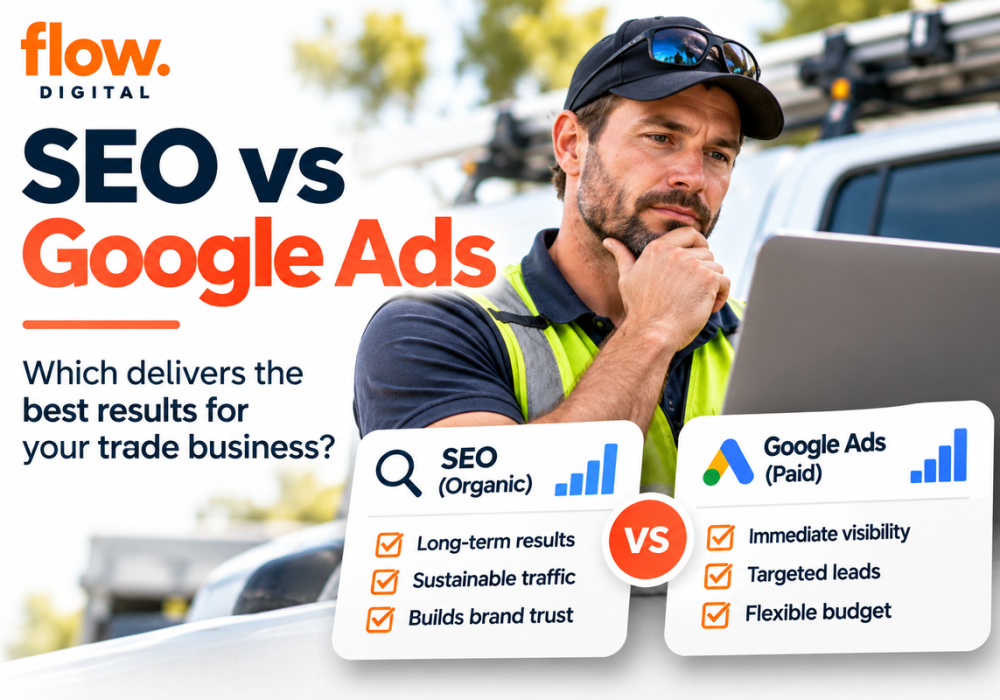
A practical comparison for trade and construction businesses deciding where to put their marketing budget
Every trade business owner who wants more work from Google eventually faces the same decision: SEO vs Google Ads. Should you pay to appear at the top of the results today, or invest in organic rankings that build over time? It is one of the most common questions Flow Marketing hears, and the right answer depends on where your business is and what it needs right now.
Both channels put your business in front of people actively searching for your services. That is what makes them so valuable compared with most other forms of advertising. But they work in very different ways, they cost money in very different ways, and they deliver results on very different timelines. Understanding those differences is the key to settling the SEO vs Google Ads question for your own business.
This guide explains how each channel works, compares them on cost, speed, longevity and trust, and sets out a simple framework for deciding which to invest in first. For most tradies, the real answer turns out to be both, used in the right order.
How SEO Works for Trade Businesses
Search engine optimisation, or SEO, is the work of improving your website and online presence so Google shows your business higher in its free results. For a tradie, that usually means two things: ranking in the Google Maps results for local searches, and ranking in the organic listings below the map for service and suburb searches.
SEO involves improving your Google Business Profile, building strong service and location pages, making the website fast and mobile friendly, earning reviews, publishing helpful content and building authority through genuine links and mentions. None of it is paid per click. Once your pages rank, every visit from those rankings costs nothing extra.
The catch is time. SEO usually takes several months to deliver meaningful results, and competitive markets can take longer. That delay is the single biggest factor in the SEO vs Google Ads decision for businesses that need leads quickly.
How Google Ads Works for Trade Businesses
Google Ads lets you pay to appear at the top of the search results for chosen keywords. You set a budget, choose the searches you want to appear for, write your ads, and pay each time someone clicks. Campaigns can go live within days, and well built accounts often start producing enquiries straight away.
Google Ads gives you a high degree of control. You can target specific suburbs, show ads only during business hours, focus on your most profitable services and adjust spending at any time. You can also see exactly which keywords and ads produce calls and forms, which makes it one of the most measurable channels available.
The trade off is that visibility stops the moment you stop paying. Google Ads is more like renting a position than owning one. That difference sits at the heart of the SEO vs Google Ads comparison.
SEO vs Google Ads: Cost
When comparing SEO vs Google Ads on cost, it helps to think about how the money is spent rather than just the total.
With Google Ads, you pay for clicks plus any management fee. Click costs for trade keywords in Australia can range from a few dollars to well over ten dollars for competitive emergency services. Your monthly spend scales directly with how much traffic you buy, and it never stops while you want the visibility.
With SEO, you typically pay a monthly fee for the work rather than for each visit. Our guide on how much SEO costs covers typical ranges. The early months cost money before results arrive, but once rankings are established, the cost per enquiry often falls well below what the same traffic would cost through ads.
Over a short horizon, Google Ads usually delivers cheaper leads, because SEO has not had time to work. Over a horizon of two or three years, SEO usually wins on cost per lead. That is why the SEO vs Google Ads cost comparison depends so heavily on how far ahead you are planning.
SEO vs Google Ads: Speed
On speed, there is no contest. Google Ads can deliver enquiries within days of launching. SEO typically shows early movement within three months, with stronger results over six to twelve months.
Apex Roof Painting, a Flow Marketing client, saw leads arrive from the very first week of a new Google Ads account, going on to generate 369 leads across 22 active weeks, with a peak of 36 leads in a single week. That kind of speed is impossible to match with SEO alone, and it is often decisive in the SEO vs Google Ads question for a business with an empty calendar.
SEO vs Google Ads: Longevity
Longevity is where SEO pulls ahead. Strong organic rankings, once earned, tend to hold for long periods with steady maintenance. The content, reviews and authority you build keep working month after month, and they become an asset that adds value to the business.
Google Ads delivers nothing once the budget is switched off. There is no lasting asset beyond the data and insight the campaigns produce. In the SEO vs Google Ads comparison, this is the clearest difference: one builds equity, the other buys immediate results.
SEO vs Google Ads: Trust and Clicks
Homeowners treat paid and organic results slightly differently. Many people click ads without thinking twice, especially for urgent needs. Others deliberately scroll past the ads to the map results and organic listings, which they see as more trustworthy.
The map results in particular carry a lot of weight for tradies, because they show reviews, photos and distance at a glance. A business with strong map rankings and plenty of reviews earns a level of trust that is hard to buy. For considered purchases, such as a renovation or a new home design, organic visibility often matters more, which tips the SEO vs Google Ads balance towards SEO for those trades.
SEO vs Google Ads: Control and Measurement
Google Ads offers precise control and clear measurement. You decide exactly which searches to target, where to show ads and how much to spend, and you can see which campaigns produce enquiries. When something is not working, you can change it immediately.
SEO offers less direct control. You can influence rankings, but Google ultimately decides who ranks. Results are still measurable through call tracking, form tracking and analytics, but the cause and effect is slower and less direct. For business owners who value certainty, this is an important factor in weighing SEO vs Google Ads.
Done badly, though, Google Ads can burn money fast. Broad keywords, missing negative keywords and poor landing pages are common causes of wasted spend. Our post on how to stop wasting money on Google Ads covers the fixes, and our guide on how Quality Score affects your cost per click explains why well built accounts pay less for each click.
When Google Ads Should Come First
Google Ads is usually the right first investment when:
- The business needs enquiries quickly, such as a new business or one facing a quiet period
- The website is new and has no organic rankings yet
- You want to test which services and suburbs produce the most profitable work
- You offer emergency services where people call the first credible result
- You have a clear budget and want precise control over spending
In these situations, the SEO vs Google Ads decision leans firmly towards ads first, with SEO started alongside so it is ready to take over as rankings grow. Flow Marketing manages paid ads for trades and construction businesses with this staged approach in mind.
When SEO Should Come First
SEO is often the better first investment when:
- The business already has steady work and wants to reduce long term marketing costs
- Click costs in your trade and area are very high
- Customers research carefully before choosing, as with building and design
- You want to build an asset that adds lasting value to the business
- You are in a smaller market where ranking can happen relatively quickly
A drafting firm like NRD Drafting and Building Design is a good example. Clients research designers carefully, often over weeks, and organic visibility for planning and design questions builds trust long before an enquiry. For businesses like this, the SEO vs Google Ads balance often favours SEO, with ads used to support specific services. Flow Marketing provides SEO for trades and construction companies designed around exactly these longer buying journeys.
Why Most Tradies Should Use Both
For most trade and construction businesses, framing it as SEO vs Google Ads is slightly misleading, because the two channels work best together. Each covers the other’s weakness.
Google Ads delivers enquiries now, while SEO builds. Ads data reveals which keywords produce real jobs, which tells you which pages to prioritise for SEO. Strong organic rankings then reduce how much you need to spend on ads over time. And appearing in both the paid and organic results for the same search increases the chance the customer chooses you.
Businesses like McPherson Window Cleaning benefit from this kind of combined approach. Flow Marketing’s SEO work with McPherson returned target keywords to page one after earlier rankings had slipped. Paid search can protect visibility during periods like that, while organic rankings recover. That is the practical answer to the SEO vs Google Ads question for most home service businesses.
A Simple Framework for Splitting the Budget
How you divide spending between the two depends on the stage of the business. As a general guide:
- New business or new website: put most of the budget into Google Ads for immediate leads, with a smaller amount into SEO foundations such as the Google Business Profile, core service pages and reviews.
- Growing business: keep Google Ads running for your most profitable services while steadily increasing SEO investment in content and local pages.
- Established business: as organic rankings strengthen, shift more budget into SEO and use Google Ads strategically for peak seasons, new services or competitive suburbs.
For a broader view of how much to invest overall, our guide on how much a tradie should spend on marketing sets out a practical framework. The right SEO vs Google Ads split will move over time as results change.
Do Not Forget the Website
Whichever way you lean on SEO vs Google Ads, both channels send visitors to the same place: your website. If the site is slow, confusing or untrustworthy, both channels underperform. A strong website lifts the return on every dollar spent on either one.
That means a clear headline explaining what you do and where, a visible phone number, fast mobile performance, reviews and project photos, and simple quote forms. Our guide on how to get more leads from your website covers the essentials, and Flow Marketing builds websites for trades and construction businesses with conversion built in from the start.
Where Meta Ads and Email Fit In
The SEO vs Google Ads debate focuses on search, but it is not the whole picture. Meta Ads on Facebook and Instagram reach people before they search, which suits visual and planned services such as landscaping, renovations and custom homes. Upmarket Homes, a Flow Marketing client, reached over 107,000 people through Meta Ads and generated 100 qualified leads at an average cost of $104 across nine months. Our guide to Facebook ads for tradies explains when that kind of approach works best.
Email marketing keeps past customers and unconverted leads engaged, turning the enquiries that search delivers into repeat and referral work. Automated email marketing makes this easy to run in the background. A trade business such as Knight Solutions, which provides practical home and property services, gets more from every search lead when follow up and retention are part of the system.
SEO vs Google Ads by Trade
The SEO vs Google Ads balance also depends on the type of trade, because different trades attract different kinds of searches and different buying behaviour. Thinking about how your own customers search makes the decision much clearer.
Emergency trades such as plumbing, electrical and locksmith work live on urgent searches. A homeowner with a burst pipe or a power outage calls one of the first results they see, and rarely compares five quotes. For these trades, Google Ads is often essential, because the top of the page is where the urgent calls happen. SEO then builds map rankings and reviews that capture the same urgent searches without the click cost.
Planned project trades such as landscaping, painting, roofing and renovations attract customers who research for days or weeks. They read articles, look at photos and compare businesses carefully. Here, the SEO vs Google Ads balance often tilts towards SEO and content, supported by Google Ads during peak seasons and Meta Ads to showcase finished work.
High value building and design businesses usually target fewer, more considered searches. Custom builders, drafting firms and architects benefit hugely from organic visibility for research questions, because it establishes expertise well before the customer is ready to talk. Google Ads still plays a role, but usually a targeted one for specific services or regions.
Recurring home services, such as window cleaning, pest control and air conditioning servicing, benefit from repeat customers. In these businesses, the SEO vs Google Ads decision should factor in lifetime value, because a customer won through either channel may book again and again. Strong map rankings and reviews tend to deliver these long term customers at the lowest cost.
Common Mistakes When Choosing Between SEO vs Google Ads
Several mistakes come up again and again when trade businesses weigh SEO vs Google Ads. Avoiding them saves a great deal of wasted budget.
- Expecting SEO to work in weeks. Giving up on SEO after two months is one of the most common and costly mistakes, because the investment is abandoned just before it starts paying off.
- Running Google Ads without conversion tracking. Without tracking calls and forms, there is no way to know which keywords produce jobs, so spending cannot be improved.
- Sending all ad traffic to the home page. Dedicated landing pages for each service convert far better than a general home page.
- Treating the two channels separately. When SEO and Google Ads are managed by different people with no shared plan, the insight from one never improves the other.
- Ignoring the map results. For local trades, the Google Business Profile is often the most valuable part of SEO, yet it is frequently neglected.
The businesses that get the best results stop thinking of SEO vs Google Ads as a competition and start treating them as two parts of the same search strategy, planned together and measured together.
How to Measure SEO vs Google Ads Fairly
To compare the two channels properly, measure them on the same terms. That means tracking enquiries and booked jobs from each channel, not just clicks, impressions or rankings.
Call tracking numbers, form tracking and a simple record of where each new job came from will show the true cost per lead and cost per job for each channel. Review these numbers monthly for Google Ads and quarterly for SEO, because SEO results move more slowly. Over time, this data gives you a clear, evidence based answer to the SEO vs Google Ads question for your own business, rather than relying on general advice.
Measured this way, most trade businesses discover that both channels earn their place. Google Ads keeps the calendar full and predictable, while SEO steadily lowers the overall cost of winning work.
Key Takeaways
- SEO vs Google Ads is a choice between building lasting rankings and buying immediate visibility.
- Google Ads delivers leads within days, while SEO usually takes several months but costs less per lead over time.
- Ads offer precise control and measurement, while SEO builds trust and an asset that keeps working.
- Start with Google Ads when you need leads quickly, and with SEO when you want to reduce long term costs.
- Most trade businesses get the best results by using both together and shifting the balance over time.
- A strong website lifts the results of both channels.
Frequently Asked Questions
Is SEO or Google Ads better for tradies?
Neither is better in every situation. Google Ads is better for fast results and precise control, while SEO is better for lower long term costs and lasting visibility. Most tradies benefit from both, used in the right order for their stage of business.
How quickly does Google Ads work compared with SEO?
Google Ads can produce enquiries within days of launching. SEO usually shows early movement within three months and stronger results over six to twelve months.
Is SEO cheaper than Google Ads?
In the short term, Google Ads often delivers cheaper leads because SEO has not had time to work. Over two or three years, SEO usually delivers a lower cost per lead because you are not paying for every visit.
Can I stop Google Ads once my SEO is working?
Some businesses reduce ad spend significantly once organic rankings are strong. Many keep a smaller Google Ads budget running for peak seasons, new services or very competitive searches.
What should I do first if my budget is small?
With a small budget, focus first on a well optimised Google Business Profile and a strong website, then add a tightly targeted Google Ads campaign for your most profitable service. This settles the SEO vs Google Ads question in a way that delivers leads while laying foundations.
Get the Balance Right for Your Business
The SEO vs Google Ads decision is not about picking a winner. It is about using each channel for what it does best: Google Ads for speed and control, SEO for lasting, lower cost visibility. Start where your business needs the most help today, and build towards a balanced mix that keeps enquiries flowing in every season.
If you are weighing up SEO vs Google Ads for your trade or construction business, we would love to help you work out the right mix. At Flow Marketing, we run both channels for trade businesses every day, and we will recommend the balance that suits your goals, your market and your budget. Get in touch and let us build a plan that delivers leads now and keeps them coming.