
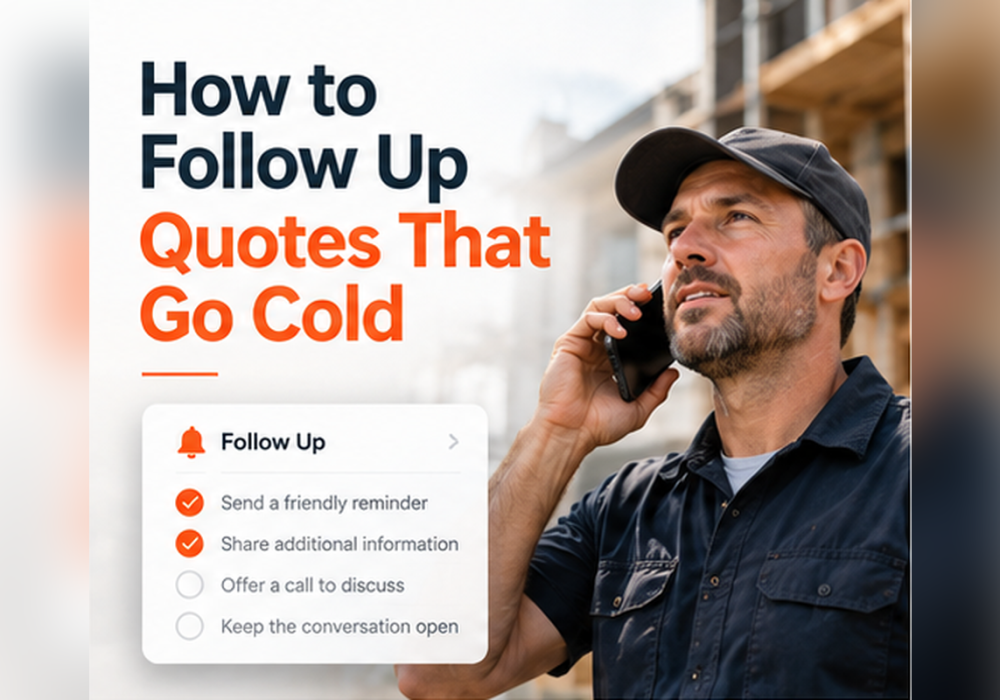
Turning silent quotes into booked jobs with a simple follow up system
Every trade business owner has sent a quote, felt good about it, and then heard nothing. The job that seemed almost certain simply goes quiet. Learning how to follow up quotes that go cold is one of the highest value skills a trade business can develop, because these are not lost customers, they are usually just distracted ones. The work of writing the quote is already done, so recovering even a fraction of these silent quotes is close to free money. This guide explains how to follow up quotes that go cold in a way that feels professional rather than pushy, and that reliably turns maybes into confirmed work.
Flow Marketing works with trade and construction businesses every day, and the pattern is remarkably consistent. Owners pour effort into generating leads and writing quotes, then let a large share of those quotes evaporate through silence. Fixing the follow up is often the fastest way to lift revenue without spending a cent more on marketing, and it is what how to follow up quotes that go cold is all about.
Why quotes go cold in the first place
Understanding why quotes go quiet is the first step to recovering them. In the overwhelming majority of cases, silence does not mean no. It means the homeowner got busy, got distracted, or is quietly comparing options and has not made a decision yet. Reading silence as rejection is the single biggest mistake trade businesses make, and avoiding it is the first lesson in how to follow up quotes that go cold.
People lead busy lives. A homeowner who requested a quote for a repaint or a repair genuinely intended to act, then life got in the way. School runs, work deadlines, and a dozen other priorities pushed the decision down the list. The quote is still sitting in their inbox, and a gentle reminder is often all it takes to bring it back to the top.
Others are simply comparing. Many homeowners request several quotes and take their time deciding. During that window, the business that stays helpfully in touch has a real advantage over the ones that quote and vanish. Knowing how to follow up quotes that go cold means being the business that is still present when the decision is finally made.
The cost of never following up
The financial cost of poor follow up is enormous, though it is invisible because it never appears on a report. Every quote that goes unanswered and unrecovered is potential revenue walking out the door, and for most trade businesses these add up to a very large number over a year.
Consider a business that sends quotes worth a healthy sum each month and recovers none of the ones that go quiet. Even lifting the recovery rate slightly would translate into several extra jobs a month, which over a year is a meaningful lift in revenue. Because the leads and quotes already exist, this is some of the cheapest growth available to any trade business.
This is exactly why Flow Marketing treats follow up as a core part of lead generation rather than an afterthought. Generating a lead is expensive. Letting it go cold after a single unanswered quote wastes that investment. A business like Knight Solutions wins more of its quotes not by quoting more people, but by following up the ones it already has.
The follow up sequence that works
The heart of knowing how to follow up quotes that go cold is having a simple, repeatable sequence rather than relying on memory and mood. A structured series of touches, spaced sensibly over a couple of weeks, recovers far more quotes than a single follow up or, worse, none at all.
A reliable pattern is to follow up within a day or two of sending the quote, then again a few days later, then once more about a week after that. Each contact should be brief, friendly, and helpful, never demanding. The goal is to stay present and make it easy to say yes, not to pressure the homeowner into a corner.
The exact spacing matters less than the consistency. What kills recovery is not the wrong interval, it is the absence of any follow up at all. A business that reliably sends three gentle reminders will comfortably outperform one that sends none, regardless of the precise timing. Building the sequence once and using it every time removes the guesswork, which is the practical core of how to follow up quotes that go cold.
What to actually say
The tone of a follow up determines whether it feels like helpful service or annoying pestering. The most effective approach is warm, brief, and genuinely useful. Each message should give the homeowner an easy reason to respond, whether that is answering a question, offering to talk through the quote, or simply checking the details still suit them.
A good first follow up might check that the quote arrived and offer to answer any questions. A second might add value, perhaps clarifying what is included or offering to adjust the scope. A final one might gently note that the business is getting booked up, giving a soft reason to decide, without ever resorting to false urgency or pressure.
Personalisation lifts response rates significantly. Referring to the specific job, the customer's name, and any details discussed shows that the business remembers them and cares about the work. A generic template blasted out impersonally performs far worse than a message that feels written for that one homeowner, even if it is built from a reusable structure.
Choosing the right channel
How to follow up quotes that go cold also depends on choosing the right channel for each customer. Email, phone, and text each have their place, and the best follow up systems use a sensible mix rather than relying on a single method. Different homeowners respond to different channels, so variety improves the odds.
Email is ideal for the quote itself and for detailed follow ups, because it keeps a written record and lets the homeowner respond in their own time. Text messages are excellent for quick, friendly nudges that get seen fast, since most people read a text within minutes. A brief, polite text can succeed where an email sits unopened.
A phone call, used well, can be the most powerful of all for higher value quotes. A quick, friendly call to check everything made sense often surfaces a question or hesitation that was quietly holding up the decision. Reserving calls for the more valuable jobs keeps them worthwhile without overwhelming the schedule.
Automating follow up so nothing slips through
The biggest reason trade businesses fail at follow up is not unwillingness, it is time. Between quoting, working, and running the business, remembering to chase every quote manually is simply unrealistic. This is where automation transforms the picture, doing the remembering so the owner does not have to.
An automated system can trigger a follow up sequence the moment a quote is sent, delivering each message at the right interval without any manual effort. The owner sets it up once, and from then on every quote is followed up reliably, whether the business is quiet or flat out. Nothing slips through the cracks because the system never forgets.
This is precisely what Email Marketing and CRM automation are built for. Flow Marketing sets up automated follow up sequences for trade and construction businesses, so that every quote receives a professional, consistent series of touches in the background. The result is more recovered jobs with less effort, which is the ideal combination for a busy owner.
Automation also captures useful data. Knowing how many quotes convert, how many respond to which message, and where deals stall lets the sequence be refined over time. This measurement turns follow up from guesswork into a system that keeps improving, much like the wider marketing approach covered across the Flow Marketing marketing guides.
Following up without being annoying
Many owners avoid following up because they fear being a nuisance. This fear is understandable but misplaced. Done properly, follow up is a service, not a pest. Homeowners are often grateful for a polite reminder about something they meant to deal with, and a helpful nudge reflects well on the business.
The key is tone and value. A follow up that offers help, answers a question, or makes the decision easier is welcome. One that simply demands an answer or repeats the same message is not. Keeping each touch genuinely useful is what separates professional follow up from irritating chasing.
There is also a natural end point. After a sensible sequence of a few well spaced, friendly touches, it is right to stop and let the quote rest. A business that knows when to ease off comes across as confident and professional. And a homeowner who was not ready this time will remember the good experience when their need returns, which is its own kind of win.
Turning follow up into repeat and referral work
The value of good follow up extends well beyond the immediate quote. The systems that recover cold quotes are the same ones that nurture past customers into repeat work and referrals. A business that stays in touch professionally builds relationships that pay off again and again over the years.
Once a follow up system is in place, it can be extended to keep past customers engaged long after the job is done. Periodic check ins, seasonal reminders, and helpful updates keep the business front of mind, so that when the customer needs more work or knows someone who does, the business is the obvious choice. This is retention marketing, and it is some of the most profitable marketing there is.
A premium property business such as Upmarket Homes thrives on exactly this kind of ongoing relationship, where past clients return and refer because the business stayed thoughtfully in touch. The same follow up infrastructure that recovers a cold quote today can nurture a customer relationship for years, which is why building it well is such a strong investment.
Timing your follow up for the best response
Getting the timing right is a big part of how to follow up quotes that go cold effectively. Follow up too soon and it can feel pushy, too late and the job may already be gone to a competitor. There is a sensible window that balances staying present with giving the homeowner room to think.
The first follow up works best within a day or two of sending the quote, while the conversation is still fresh and the homeowner still has the project in mind. This early touch confirms the quote arrived and reopens the conversation before the enquiry cools. Waiting a week for the first contact is one of the most common errors in how to follow up quotes that go cold.
Subsequent follow ups can be spaced a little further apart, giving the homeowner time without letting the business fade from memory. A second touch a few days after the first, and a third about a week later, keeps the business present through the decision window. The exact intervals matter less than simply having a sequence rather than a single attempt.
There is also value in matching the timing to the type of job. A small, urgent repair warrants faster follow up than a large project a homeowner is carefully considering. Reading the situation and adjusting accordingly is part of how to follow up quotes that go cold in a way that feels attuned to the customer rather than mechanical.
Why a system beats relying on memory
The difference between businesses that master how to follow up quotes that go cold and those that do not usually comes down to systems. Relying on memory and good intentions fails, because busy owners inevitably forget, and the quotes that slip through the cracks are pure lost revenue. A system removes the reliance on memory entirely.
A simple system can be as basic as a spreadsheet or as sophisticated as a full CRM, but the principle is the same, which is that every quote enters a process that ensures it gets followed up. Nothing depends on the owner remembering at the right moment, because the system prompts or acts automatically. This reliability is the heart of how to follow up quotes that go cold at scale.
Automation takes this further by removing the manual effort as well as the memory. An automated sequence triggers the moment a quote is sent, delivering each follow up at the right time without the owner lifting a finger. Flow Marketing builds exactly these automated sequences using Email Marketing and CRM tools, so that following up happens reliably in the background.
The payoff compounds over time. A business that reliably follows up every quote recovers a steady stream of jobs it would otherwise have lost, month after month. Because the leads and quotes already exist, this is some of the highest return activity a trade business can invest in, which is why how to follow up quotes that go cold deserves as much attention as generating the leads in the first place.
Measuring and improving your follow up
Like every part of marketing, how to follow up quotes that go cold improves when it is measured. Tracking what happens to quotes reveals how many are being recovered, which messages work best, and where the process can be sharpened. Without measurement, follow up is guesswork, and guesswork leaves money on the table.
The most basic and important metric is the quote conversion rate, which is the share of quotes that become jobs. Watching this number before and after introducing a proper follow up sequence quickly reveals the impact. For most trade businesses, the lift is significant, which makes a compelling case for taking how to follow up quotes that go cold seriously.
Digging deeper, it helps to know which follow up in the sequence tends to win the job, and through which channel. This insight allows the sequence to be refined, emphasising what works and trimming what does not. Over time, a well measured follow up process becomes steadily more effective, much like a well tuned advertising campaign. The same discipline that improves Paid Ads applies here too.
Building follow up into your whole sales process
The businesses that truly master how to follow up quotes that go cold do not treat follow up as a separate task bolted on at the end. They build it into the whole sales process, so that following up is a natural, automatic part of how every quote is handled. This integration is what makes follow up reliable rather than occasional.
It starts at the quote itself. Setting expectations when the quote is sent, letting the homeowner know the business will check in, makes the follow up feel expected and welcome rather than intrusive. This small framing changes the entire dynamic, turning how to follow up quotes that go cold from an awkward chase into a professional service the customer anticipates.
From there, every quote enters the same follow up process automatically, with no reliance on the owner remembering. This is where Email Marketing and CRM automation prove their worth, triggering the sequence the moment a quote goes out. Flow Marketing sets up these systems so that how to follow up quotes that go cold becomes something the business does effortlessly, every single time, in the background.
Integrating follow up this way also produces valuable data across the whole sales process, showing where quotes stall and which approaches recover them. This insight feeds back into improving the process, so the business gets steadily better at how to follow up quotes that go cold over time. The result is a sales process that quietly recovers revenue that would otherwise be lost.
Following up as part of a bigger marketing system
Knowing how to follow up quotes that go cold delivers the most value when it sits within a joined up marketing system, rather than standing alone. Follow up is the final step that ensures the leads generated by every other channel actually convert into revenue, which makes it the crucial link that protects the whole marketing investment.
Consider the journey. SEO and Paid Ads generate the enquiry, a strong website converts it into a quote request, and the quote is sent. Without follow up, a large share of those hard won quotes simply evaporate, wasting all the effort and money that produced them. This is why how to follow up quotes that go cold matters so much, because it protects the return on everything upstream of it.
The same systems that recover cold quotes also nurture past customers into repeat and referral work, extending their value far beyond the immediate job. A business that stays professionally in touch builds relationships that pay off for years, turning a single follow up sequence into a long term relationship engine. This is retention marketing, and it flows naturally from mastering how to follow up quotes that go cold.
Seen in full, follow up is not a minor administrative task but a central pillar of profitable trade marketing. Flow Marketing builds it into the wider system for its clients, because how to follow up quotes that go cold is one of the highest return skills a trade business can develop, turning existing leads and quotes into far more booked jobs.
Key takeaways
To recap how to follow up quotes that go cold, remember that silence rarely means no. A structured sequence of a few friendly, well timed touches recovers a meaningful share of quotes that would otherwise be lost.
The most reliable way to handle how to follow up quotes that go cold is to automate it, so every quote is followed up without depending on memory. Email, text, and the occasional call each play a part.
Built into the whole sales process and measured over time, how to follow up quotes that go cold becomes one of the cheapest sources of growth a trade business has, because the leads and quotes already exist.
Frequently asked questions
How do you follow up quotes that go cold without being pushy?
The key to how to follow up quotes that go cold without being pushy is to keep each message warm, brief, and helpful. Offer to answer questions or clarify the quote rather than simply demanding an answer, and stop after a sensible sequence of a few touches.
How many times should you follow up a quote?
A reliable approach to how to follow up quotes that go cold is three well spaced touches over a couple of weeks, one within a day or two, another a few days later, and a final one about a week after that. Consistency matters more than the exact timing.
What is the best way to follow up quotes that go cold?
The best way to follow up quotes that go cold is with an automated sequence that triggers the moment a quote is sent, so nothing is forgotten. Combining email, text, and the occasional phone call for higher value jobs recovers the most work.
Does following up cold quotes actually win more jobs?
Yes. Learning how to follow up quotes that go cold is one of the highest return activities a trade business can invest in, because silence usually means a distracted homeowner rather than a lost job. A gentle reminder recovers a meaningful share of quotes.
Bringing it all together
Knowing how to follow up quotes that go cold comes down to a simple truth, which is that silence rarely means no. With a structured, friendly, well timed follow up sequence, delivered across the right channels and ideally automated so nothing is forgotten, trade businesses can recover a meaningful share of the quotes they would otherwise lose. It is some of the cheapest, fastest growth available, because the leads and quotes already exist.
At Flow Marketing, we build the automated follow up systems that turn silent quotes into booked jobs for trade and construction businesses. If quotes are slipping away into silence and you know some of them should have been yours, we would love to help you fix that. Get in touch and let us set up a follow up system that quietly wins back the work you are currently leaving on the table.